Introducing the Volerion Vulnerability Intelligence Platform
-
 Ruben Bos
 - 13 Apr, 2026
Most vulnerability dashboards are not effective for daily use. They start promising but quickly become a source of noise. Analysts end up manually checking data instead of making decisions. The problem is not the dashboard itself, but the incomplete data it runs on.
Today, we are introducing the Volerion Vulnerability Intelligence Platform beta. It is a practical system to turn vulnerability data into decisions at scale. The dashboard is available at app.volerion.com.
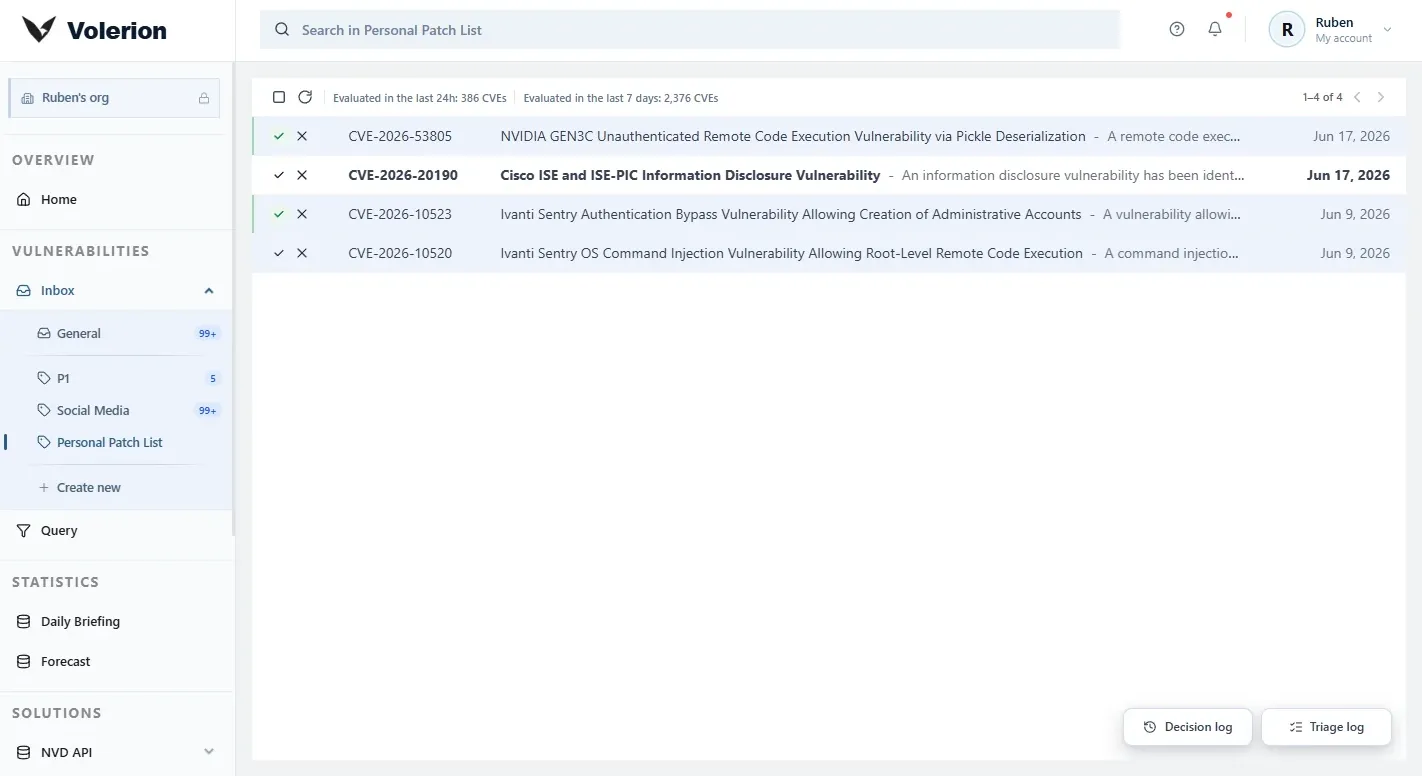
Built on Complete CVE Intelligence
Most vulnerability dashboards look polished, but many run on incomplete or incorrect data. That creates noise for security teams and forces analysts to keep verifying records by hand. We took a different approach at Volerion. We fixed the data problem first by analyzing each and every CVE in-house and filling gaps when public records miss details like CPEs or CVSS scores. Only after that did we build the dashboard layer.
Having this complete set of data is why the first primary feature of our dashboard is CVE Inbox.
Meet CVE Inbox
CVE Inbox is the first primary feature of our dashboard. It works differently than you might expect. You do not need to write complex queries to get started. Instead, you tell us what you care about in plain text. This can be specific, like “all vulnerabilities in Grafana,” or broader, like “vulnerabilities relevant to the healthcare sector”
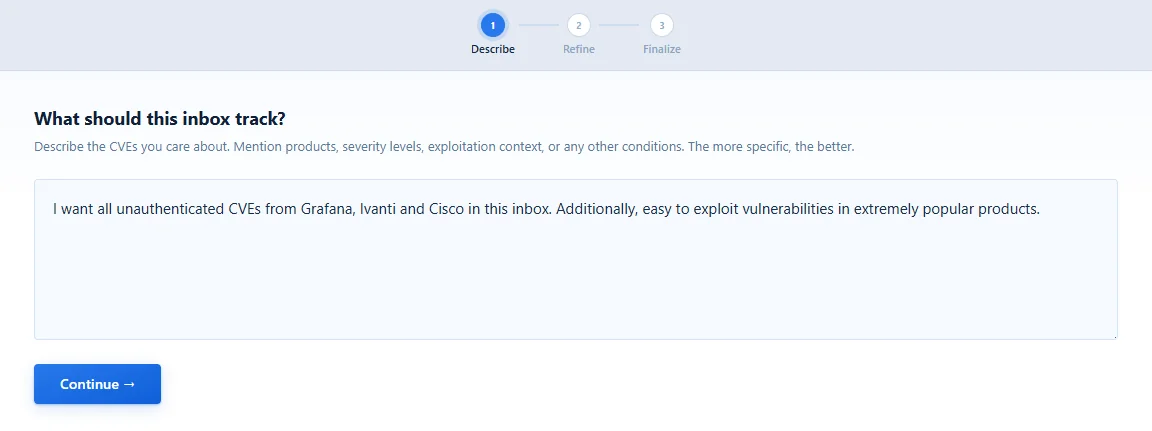
The agent responsible for managing that inbox may ask a few follow-up questions to refine the scope so it can filter with confidence. If your initial requirements are already specific enough, it may not ask anything at all. Those follow-up answers and your original requirements are stored per inbox, and you can revise them at any time.
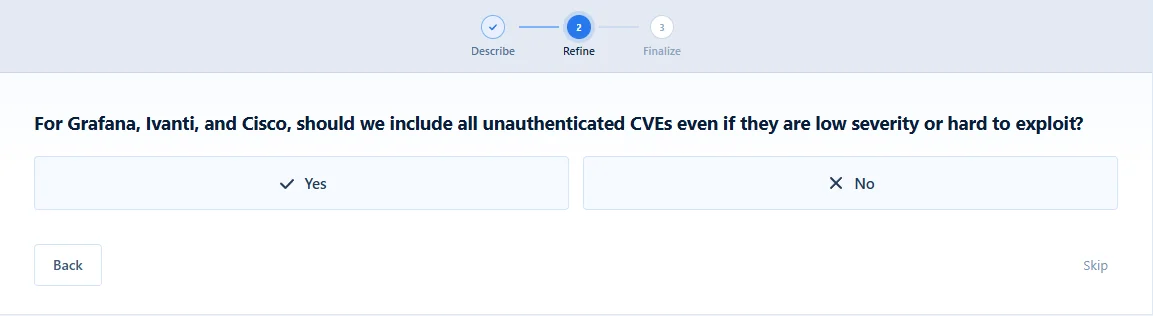
From that point on, our agents monitor new vulnerabilities and deliver them to your inbox if they match your criteria. You get the signal, not the noise.
Each matched CVE can then be triaged directly in the inbox. You can mark a row as good or not good and provide a reason for that decision. This helps your team triage faster, and it also helps the inbox agent learn from your feedback to improve future matching decisions. For example, if a vulnerability matched but is not something you want to see in that inbox, you can mark it accordingly and explain why so the agent can make better decisions next time.
Integrations
An inbox is just the start. It is a way to filter the CVEs that matter to you. What happens next is what is most important.
You should not be forced to constantly check our dashboard. That is why we let you configure integrations per inbox, which define what happens when a CVE matches. You can send matched CVEs to Slack, create Jira tickets, and route them directly into the workflows your team already uses.
If you need an integration we do not support yet, we are open to feature requests.
Private Beta
We are currently running a private beta with a small number of security teams. We are especially looking for teams that are overloaded by noisy dashboards or brittle alert pipelines and want a more reliable way to triage CVEs.
During beta, we work closely with each team to shape inboxes, improve matching quality, and prioritize integrations around real workflows.
If this sounds like you, we want to work with you.
Want to see whether Volerion fits your workflow? Email contact@volerion.com or schedule a meeting. If you share your current triage use case, we can show you how to turn it into the right inboxes, filters, and downstream integrations.